


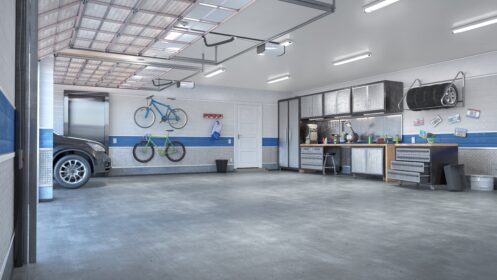
Many retail spaces use polished concrete flooring for a long-lasting shine. Businesses like tire shops, bike stores, car dealerships, and 4×4/ATV dealers frequently move equipment that leaves ugly marks on the floor. Other common issues include fluid drips, rubber deposits, and boot scuffs. None of that is going to go away, and it often can’t be prevented. The question to ask yourself if you have a business with these considerations is whether your floor is working with you or against you.
At Valley Concrete Coatings & Polishing in Phoenix, AZ, we offer commercial garage flooring for all types of businesses. We can recommend a specific type of concrete polishing for your business, including for retail spaces that expect heavy floor wear from equipment. Not only does it look good, but it can hold up well with proper planning and application. The trick is knowing which variables to factor in before the crew ever touches your floor. Our professionals are ready to help all Greater Phoenix-area business owners transform their spaces with polished concrete.
Why Polished Concrete Works Well
A polished concrete floor gives a clean appearance that can make a good first impression on customers. Polished concrete is dense, which makes it durable. Mechanical grinding, combined with chemical hardeners, closes the concrete’s pores. This means that the concrete can’t absorb oil, chemicals, or rubber. Instead, these substances remain on top of the finish, making them easier to wipe away and clean. That’s not possible with many other flooring types.
Increased durability is only one positive aspect of polished concrete. Another concerns how the floor appears as light hits it. A polished floor bounces light around in a way that other concrete doesn’t. Having that shine can make the showroom floor look brighter and enhance the appearance of your merchandise. You don’t have to worry about stripping, buffing, or waxing. A polished concrete floor in your commercial space can last decades with only basic maintenance.
Variable Gloss Levels
One of the most important considerations you have when you’re planning a polished concrete floor is the gloss level. While all polished concrete has some shine, the amount of shine is determined by the polish level and finish. Shinier isn’t always better, particularly in areas subject to regular vehicle traffic.
Polished concrete gloss is measured by how much light the surface reflects, which is typically measured with a gloss meter. However, in practice, the industry often uses grit levels to describe the polishing stage and the floor’s approximate sheen.
At the high end of the spectrum, 1,500 to 3,000 grit produces a very reflective surface that can resemble polished stone. While this mirror-like appearance can look impressive, it also tends to reveal small imperfections. Boot scuffs, dust, and tire marks can become more noticeable because they contrast with the reflective surface. For that reason, ultra-high gloss finishes are rarely used in working garages, though they may be appropriate in spaces like a motorcycle showroom where vehicles are moved carefully and traffic is limited.
A more practical range for many commercial environments is 800 to 1,200 grit, which produces a semi-gloss finish. This level still offers a refined, intentional appearance without looking like unfinished concrete. Because the surface is slightly less reflective, minor marks and scuffs tend to be less noticeable and blend in more easily. A helpful comparison is the difference between gloss and satin paint finishes. Both look attractive, but satin tends to hide everyday wear more effectively.
Another option is a 400 to 600 grit finish, which results in a low-sheen or satin appearance rather than a completely matte surface. This level is often chosen when durability, traction, and ease of maintenance are the primary goals. It’s less common in showrooms where appearance is important. However, it can be a practical choice for warehouses, service bays, or industrial spaces where performance matters more than appearance. Even at this lower polish level, the floor still benefits from polished concrete’s strength, dust resistance, and easy maintenance.
Depth of Grinding
Polished concrete is created by mechanically grinding and refining the surface of a concrete slab. As the surface is ground, different layers of the concrete’s aggregate are exposed. The depth of grinding determines how much of the aggregate becomes visible, which changes the overall look of the floor. Concrete is made from a mixture of cement paste, sand, and stone aggregate. When grinding exposes more of these materials, it creates natural variation in color and texture, so each polished concrete floor has a slightly different appearance.
A very light grind gives a cream finish, where most of the original cement paste remains intact. This creates a smooth and fairly uniform surface. However, the consistent color can make scuffs, tire marks, and dust more noticeable. Grinding slightly deeper exposes the fine aggregate in the slab, creating what is commonly called a salt-and-pepper finish. The small specks of sand and fine stone give subtle variation that helps disguise everyday marks and wear. Because it balances a refined appearance with practical durability, this finish is commonly used in showrooms and other customer-facing commercial spaces.
Grinding deeper exposes the larger aggregate within the concrete. This finish reveals the larger stones throughout the floor and produces a more decorative, mosaic-like appearance. The added variation can help hide scuffs, marks, and uneven wear over time. However, because achieving full aggregate exposure requires more grinding, it is usually more expensive. It is typically used for decorative commercial environments rather than basic warehouse floors.
Colors, Densifiers, Sealers, and Coating Guards
Tire marks are dark, so flooring in vehicle-heavy areas should be a bit on the darker side. This helps hide the marks and other spills. Earth tones and warm greys are often used because they can mask the appearance of these marks and grime.
As part of the finishing process, polished concrete surfaces get several layers of chemicals that affect the look and durability. Densifiers soak into the slab and react with the concrete, making it harder and more abrasion-resistant. For additional protection, a penetrating sealer or stain guard is often applied. In vehicle-heavy spaces, penetrating products are preferred because they soak into the concrete and resist tire marks and mechanical wear. Less expensive topical sealers form a surface film that can scratch, peel, or delaminate under rolling tires. This makes them less ideal for heavy-traffic areas.
Our team at Valley Concrete Coatings & Polishing provides professional service for polished concrete floors in the Phoenix area, as well as residential projects. We also offer epoxy flooring and chemical-resistant flooring for a variety of applications. Once the flooring is installed, you can contact us for restoration services to keep it looking fresh. Our team is ready to work with you, so give us a call today.